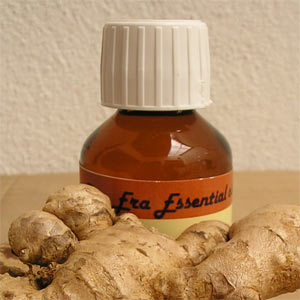
Ginger Oil
The most pungent Ginger oil comes from Ceylon
Buy Now
Ginger Oil is distilled from Ginger the rhizome of the plant that has been known for long as a spice and an ingredient in traditional medicine. The Sri Lankan ginger is an indigenous variant called "Sidda", the rhizomes being smaller are much more pungent in taste than other varieties.
Ginger oil is obtained by steam distillation of the dried rhizomes. The ginger oleoresin is prepared by solvent extraction of the dried raw material. The oleoresin contains both essential oil and pungent principles.
Uses
Ginger oil is used in the treatment of the following: Fractures, rheumatism, arthritis, bruising, carbuncles, nausea, hangovers, travel and sea sickness, colds and flu, catarrh, congestion, coughs, sinusitis, sores on the skin, sore throat, diarrhea, colic, cramps, chills and fever.
Ginger oil is well suited to help ease colds and flu, nausea, motion sickness, morning sickness, muscle aches and pains as well as poor circulation and arthritic pain.
Its warming qualities are good to use for feelings of loneliness and winter depression, and its energizing properties make it a good aphrodisiac.
In vapor therapy it can be used to help relieve catarrh, lethargy, nausea, colds, flu, feeling of loneliness and loss of libido.
In blended massage oil or diluted in the bath it can be used for arthritis, rheumatism, lethargy, colds and flu, muscle aches, poor circulation and digestive upsets.
As a constituent of blended cream it can be used for arthritis, muscle aches, rheumatism, and poor circulation.
When used with hot compresses, Ginger oil can be used for arthritis, rheumatism, muscle aches and even digestive upsets.
For ease of use, when applying a drop of oil to a handkerchief for quick inhalation it can be used for nausea, morning sickness, indigestion, colds and flu and travel sickness.
Techinical Specifications
- Specific gravity at 25 deg C 0.865 - 0.880
- Refractive index at 25 deg C 1.487 - 1.490
- Optical rotation at 25 deg C 25 to 45
- Ar-Curcumene min. 21 %
- Beta Bisablene 30 %
- Camphene 17 %
- Beta Phellandrene 9 %